





The Epilepsy Pedigree is based on the 'EPI-pedigree' & 'EPI-figure' that were developed for the Finnish Spitz breed. Affected dogs and their relatives are marked in a 5-generation pedigree with letter coding as follows:
I = Affected dog;
P = Parent is epileptic;
O = Offspring is epileptic;
S = Sibling is epileptic;
H = Half-sibling is epileptic.
The pedigree will also show the Epilepsy Figure for each dog with a colored icon behind the number. A green downwards arrow icon  means the dog's Epilepsy Figure is currently below the mean figure for healthy Tamaskan Dogs. An orange upwards arrow icon
  means the dog's Epilepsy Figure is currently at or above the mean figure for healthy Tamaskan Dogs. A red exclamation icon
  means the dog's Epilepsy Figure is currently at or above the mean figure, minus 1 (the numerical value that's assigned to the affected dog themselves), for epileptic Tamaskan Dogs.
Note: When calculating the Epilepsy Figure, it is not taken into account if a dog has e.g. several epileptic offspring. Any affected relatives are therefore only taken into account once for each dog.
The Epilepsy Figure is calculated by giving a numerical value (Z) to each letter code, which defines the COR (Coefficient of Relationship) to the affected dog:
I = 1;
P, O, S = 0,5;
H = 0,25.
Furthermore, the generations of the pedigree are given a value (K) which corresponds to the % contribution of genes:
1st generation = 1;
2nd generation (parents) = 0,5;
3rd generation (grandparents) = 0,25;
4th generation (great-grandparents) = 0,125;
5th generation (great-great-grandparents) = 0,0625.
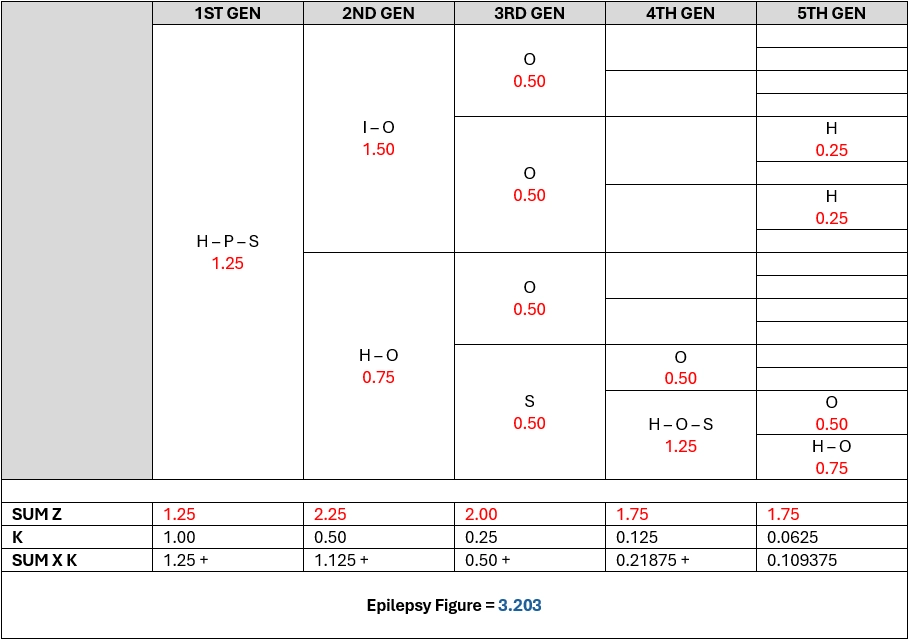
The rest is just mathematics, summing up the Z value for each generation, then multiplying the sum of Z to K. See the following example:



© 2026 Tamaskan Dog Association | Privacy Policy